


I spent a couple years of my life devoted to cooking, moving around Austin working part-time gigs and then eventually something more stable - long enough to run sauté, short enough that I would never call myself a chef. But kitchens compress time, and even a brief residency inside one teaches you things that never leave - and somewhere in that period, without anyone ever saying it aloud, I came to understand that the people keeping the lights on are not the ones you'd expect. Nobody teaches you this. It is not written anywhere, and no chef pulls you aside to explain it. You piece it together slowly, through observation: the unannounced gift from the kitchen sent out to a table of no particular fame, the extra course that appears for no reason a stranger could detect - sent because the restaurant is grateful, because these people keep coming back, because we wanted them to feel, and to be, seen. They are not the Saturday night two-tops celebrating something, or the critics, or the tables of six ordering with ambition. They are the regulars. The man who comes in twice a week and orders the same thing. The couple who sit at the bar because the bar knows them. Regulars are the steady pulse beneath a business that otherwise lives and dies by the whims of weather, holidays, and whatever the city has decided to care about that month - and a restaurant that earns them, genuinely earns them, has accomplished something that no amount of press can manufacture.
Houseman was built for regulars. This is not an interpretation; it is close to a mission statement. The name comes from husmanskost - a Scandinavian word meaning, roughly, “everyday food” - and when chef Ned Baldwin opened the restaurant in June of 2015, the question he kept asking himself was disarmingly simple: what’s in the restaurant that I want to go to? The answer sits on a quiet, tree-lined stretch of Greenwich Street in Hudson Square, a sliver of lower Manhattan that is technically west of SoHo, south of the West Village, and north of Tribeca, and that nobody - including, charmingly, the restaurant itself - can quite claim belongs to any of them.
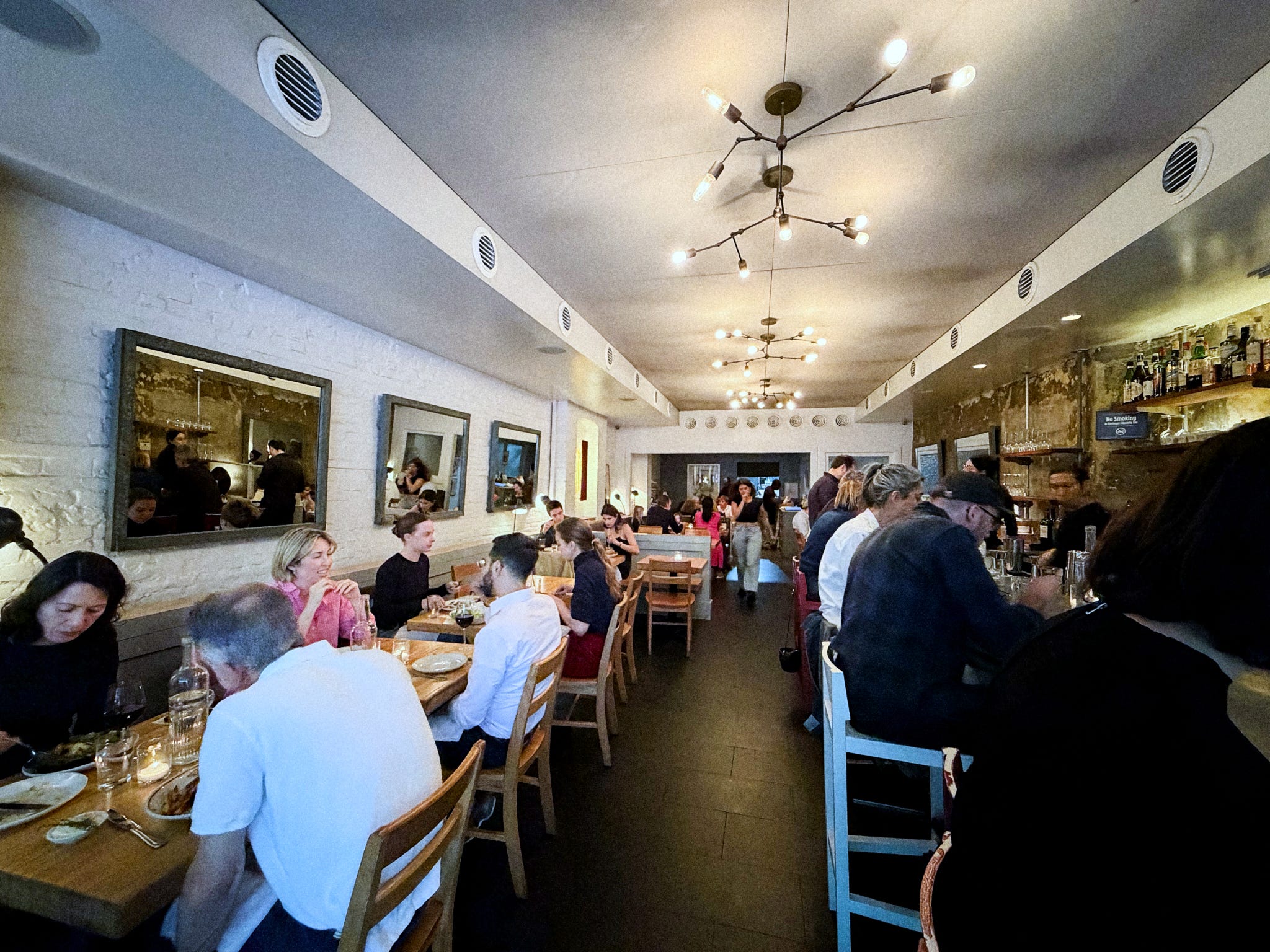
Baldwin’s path to that question is its own story. He earned an MA in sculpture from Yale and spent years as a visual artist and builder before deciding, at 36, that the thing quietly consuming his attention - cooking - deserved his full commitment. He apprenticed under Alain Ducasse and Jean-Georges Vongerichten, passed through Tom Colicchio’s Craft, and eventually became chef de cuisine at Prune, Gabrielle Hamilton’s East Village institution, where he spent the better part of five years absorbing a philosophy that prized honesty over spectacle. All of which is to say: Houseman is what happens when a man who spent half his life learning how to build things decides to build a restaurant - not a concept, not a brand, but the actual thing, with old walls left old, schoolhouse chairs, a zinc bar, and tables cut from reclaimed bowling alley maple.
We went on a Friday night and sat at the bar, which is where Houseman makes its clearest case. The room runs long and narrow - whitewashed brick on one side, raw weathered plaster on the other, branching fixtures overhead casting the kind of light that flatters everyone equally - and from a stool at the zinc you can watch the whole operation breathe. What struck me first was not the food. It was the greetings. Diners walking in and being received by name. The unhurried conversation between the staff and a man eating alone who had clearly done this exact thing, in this exact seat, many times before. Our bartender was the kind you remember - knowledgeable without performing it, attentive without hovering, the sort of person who makes a seat at the bar feel less like a consolation prize and more like the room’s best-kept secret. We drank Mexican Cokes from the bottle, cold and sweet with real sugar, and at no point did anyone make us feel that this was anything less than a complete and correct order.
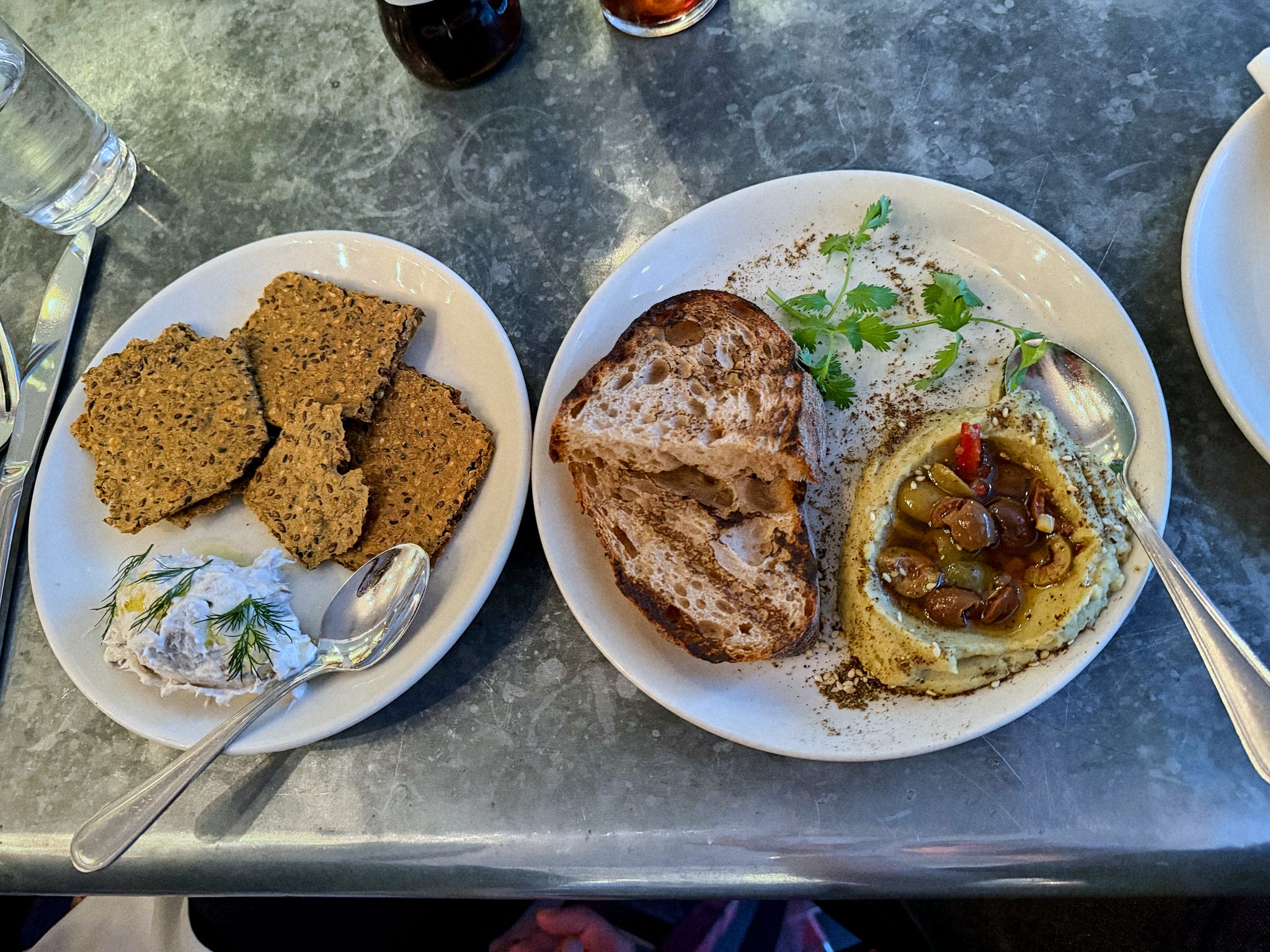
The food began with the Smoked Bluefish and the Fava Hummus. The bluefish - smoked in-house, folded into something cool and creamy, capped with fresh dill - came with seeded crackers built for structural duty, and the whole thing tasted like a fisherman’s idea of luxury, which, given that Baldwin is a devoted fisherman whose menu always carries whatever is running locally, is exactly what it was. The hummus wore a pool of marinated olives at its center and a dusting of za’atar at its edges, with thick slabs of grilled sourdough whose char carried into everything it touched. Two openers, two different instincts - one from the water, one from the pantry - both landing in the same unhurried register.
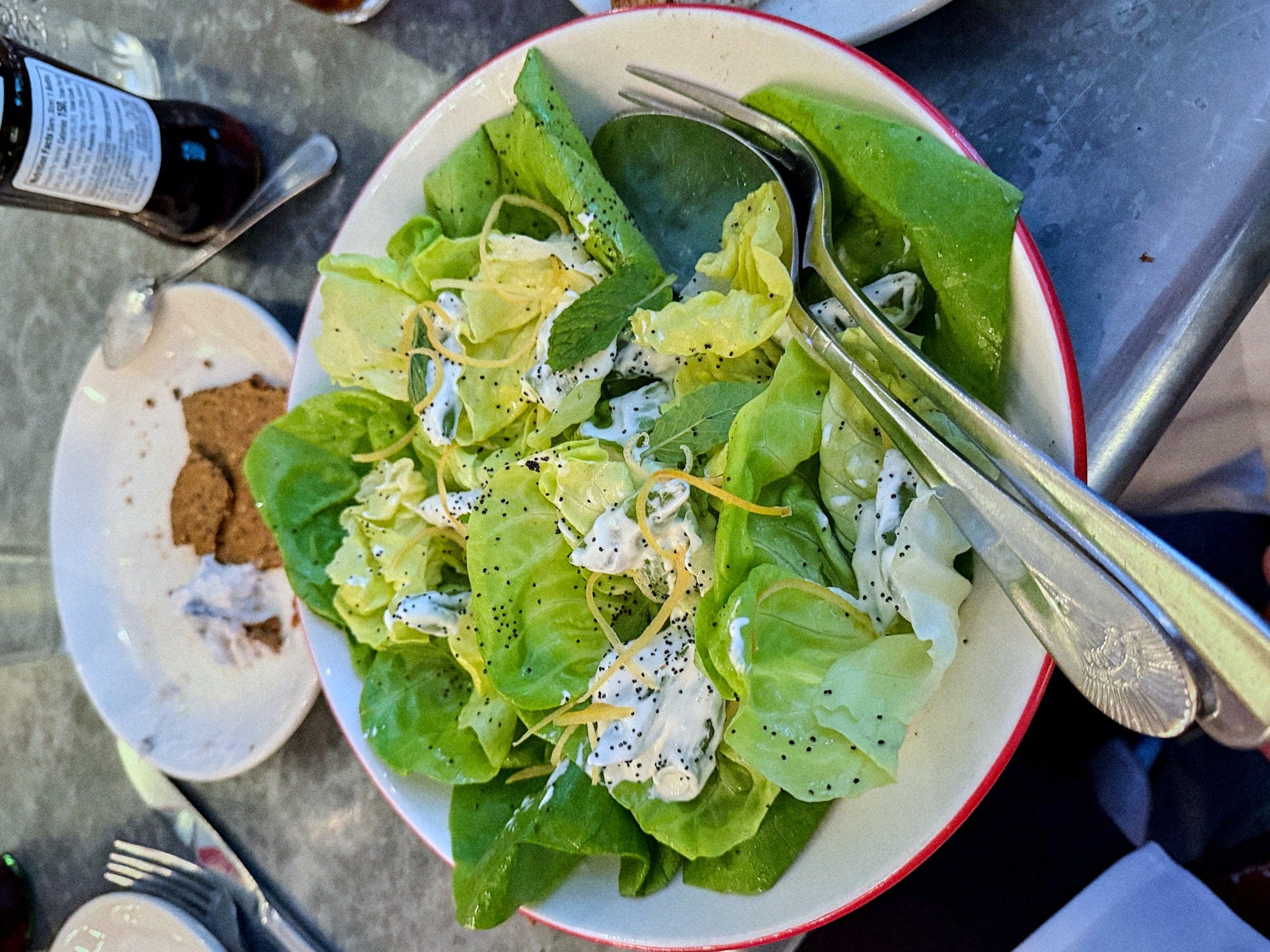
The Butter Lettuce, Snap Peas, Lemon, Labne was the surprise of the night. A pile of impossibly fresh butter lettuce - crisp, cold, structurally perfect - dressed in labne flecked with poppy seeds, painted with threads of lemon zest and whole mint leaves, the citrus lifting everything without announcing itself. A salad this simple has nowhere to hide, and so it stands entirely in the open - every leaf accountable, every element doing precisely what it claims to do, holding your attention with nothing but freshness and proportion. It was, genuinely, one of the best things we ate.
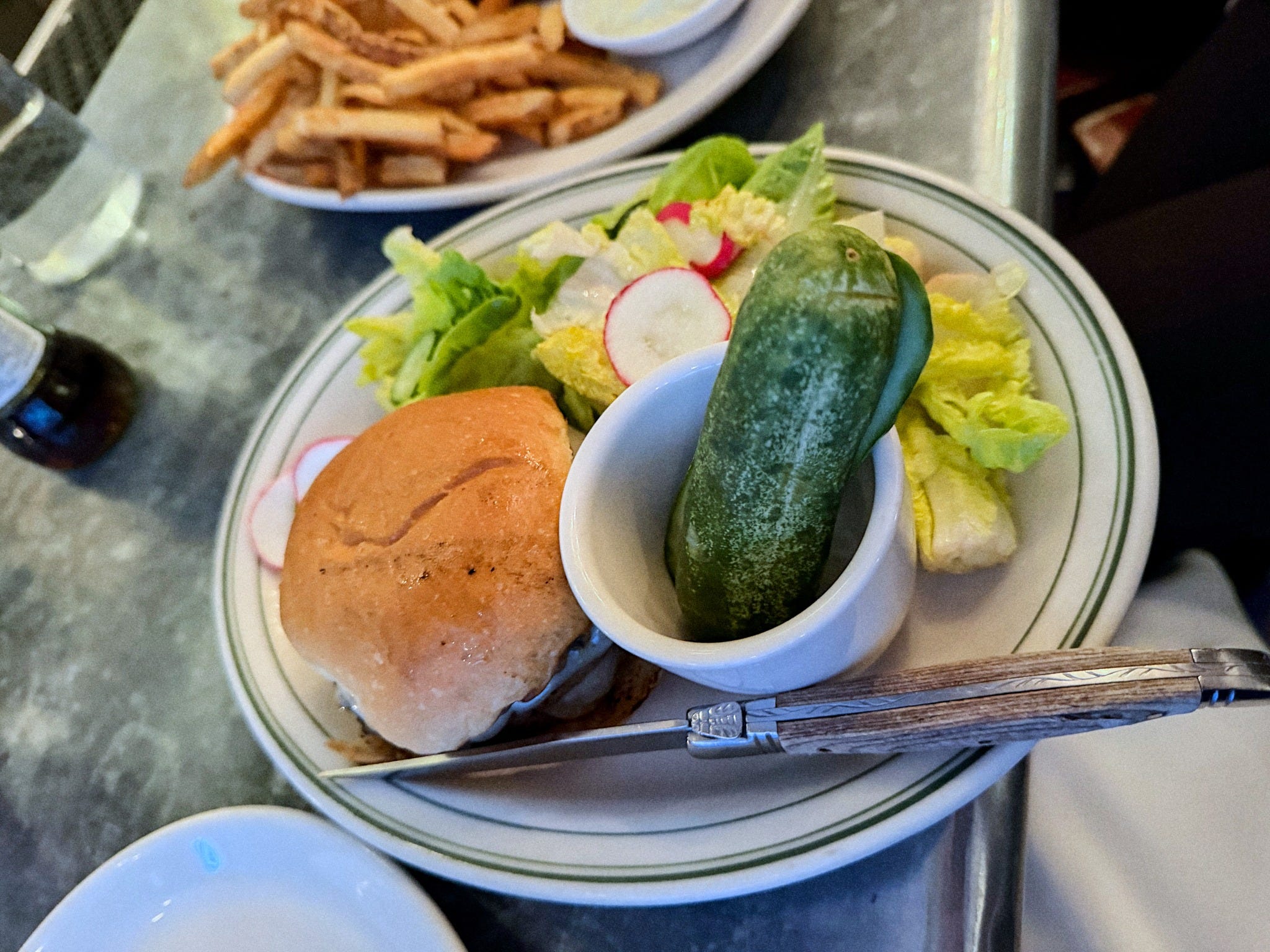
The Houseman Burger came the way burgers should - unfussy, properly cooked, a cool, barely-pickled cucumber standing upright in its own ceramic cup like it had somewhere to be. If the steak is the plate this city makes pilgrimages for, the burger is the one the neighborhood orders without opening the menu - the Tuesday answer, the plainest and most fluent expression of husmanskost in the building. There is a particular comfort in a burger that knows exactly what it is.
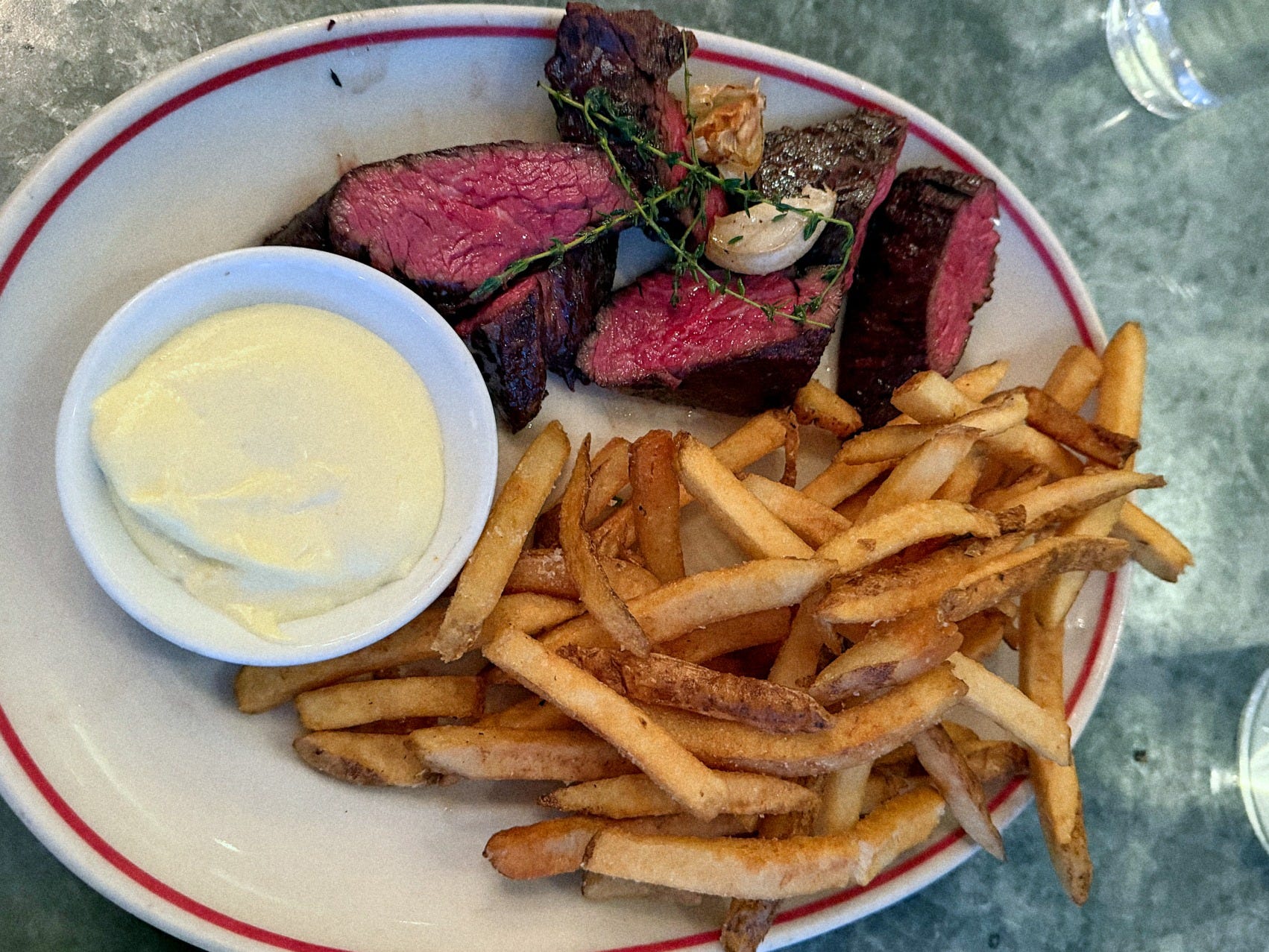
The Steak and Fries is the headline, and it earns the type size. New York Magazine has called Houseman’s hanger steak the best in the city, and the plate that reached us made the case without apparent effort - thick slices cooked to a deep, even rose, the crust dark and mineral, confit garlic cloves and a sprig of thyme resting on top, a ramekin of aioli alongside. And the fries. I have eaten a great many French fry in my life with ample enthusiasm, and these are my favorite kind, full stop - thin but not shoestring, golden to the point of amber, crisp through the entire bite, and carrying, just beneath the salt, a faint bright note of vinegar - the ghost of a salt-and-vinegar chip, the kind of detail you notice mid-sentence and lose the sentence over. The Michelin Guide describes them as fluffy, crispy, and perfectly salted, which is accurate and still somehow undersells the experience of eating them at the bar on a Friday night with a cold Mexican Coke.
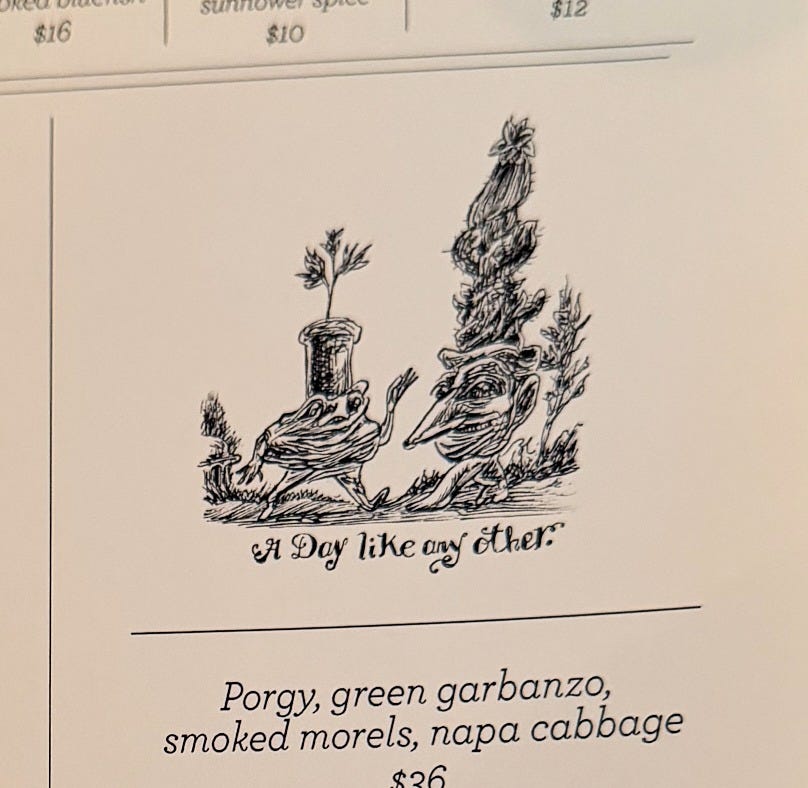
There is a small illustration on the Houseman menu - two cheerful, vaguely mythological creatures strolling through grass - captioned with four words: A Day like any other. I keep thinking about that caption, because it is the entire restaurant in a sentence. Houseman will hold your birthday, your anniversary, your celebration, and hold them well - but its quiet genius is the Thursday. The steak and a glass of red, alone at the bar, no reservation, no performance of any kind - just a room that knows you, food made by people who mean it, and the quiet, durable pleasure of being a regular somewhere. From my days on the line I can tell you that those people are the ones who keep a restaurant alive. Houseman seems to have understood this from the very beginning, and built itself, plank by reclaimed plank, in their image.
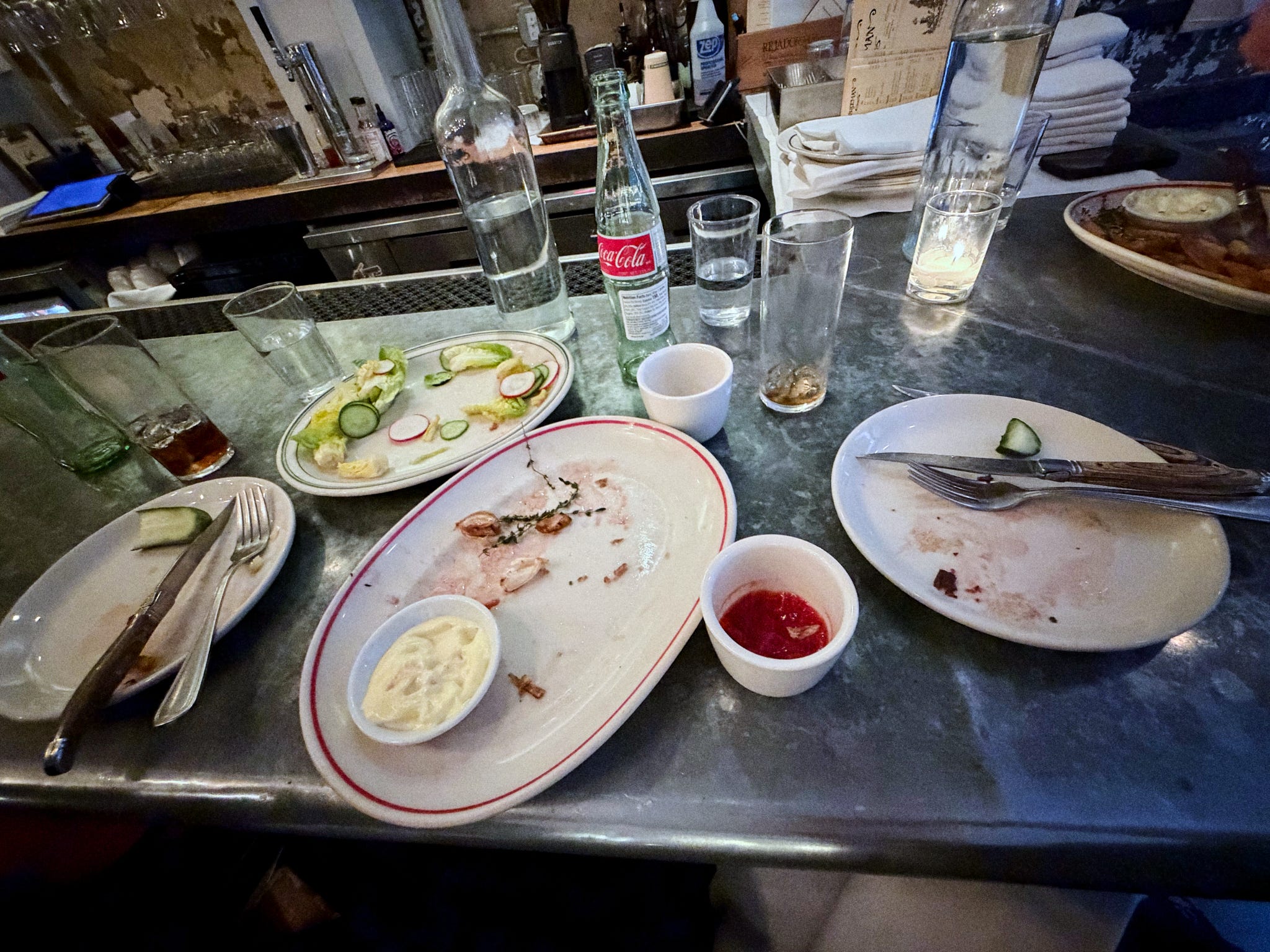
Dinner nightly. Lunch weekdays, brunch on weekends. Walk in, sit at the bar.
My spouse and I are “regulars” at a popular restaurants in our city. We are treated like royalty, and the food is outstanding, always. It’s great to be known there by the chef/owner and the staff. And in this economy, restaurants need regulars to stay afloat.