

Netflix’s “The Ultimatum” and your 3 adjectives
and the art of communication. Discussed here.

Do we really understand what we say? I have thoughts on this, but I can best convey my point if you let me start at the top of the rabbit hole. Ok?
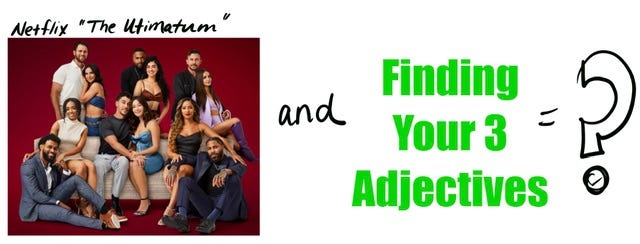
Have you watched “The Ultimatum?” A reality show featuring six couples, each of whom have been given an ultimatum by one of their partners to marry…..or else! And, as logic would have it, the solve for working through this deeply personal decision is to go on television and switch partners with others in the same boat.
It doesn’t escape me that I’ve sometimes wished for various team mates to do the same: you’re unhappy here at Tibi? Fine, go work for brand XYZ, then let me know how you really feel. But I don’t say it out loud, because reality is I don’t want them to leave and I’m usually of the mind that we can work it out without the drastic measure. Fact though, if an employee has held a job at another company, they have a built in measuring stick and rarely engage in “grass is greener” thinking. They’re more aware of what they signed up for and why. While this is a general truism - there are exceptions - I’m thinking of a handful of colleagues right now that have been with us from the beginning. The absence of comparative experiences is neutralized with open conversation and assumptions of positive intent.
But with these highly toned individuals on t.v., we’re talking relationships here! Couples doing the ultimate swingers move and switching partners for an eight week trial marriage with a Netflix microphone strapped to their chest, seems hardly the logical alternative to lived experiences. And as absurd as it sounds, it wasn’t the premise that struck me as crazy so much as how un-crazy the participants spoke and sounded.
It made me think: when un-crazy speak rules, crazy thrives. At first pass, the words of Hayley, Blake, Ashley and Killian sounded so mature, respectful. Thoughtful. Never mind that while they professed mutual admiration in their abilities to “recognize boundaries”, “process” and “hold space” they were in each other’s partners beds sipping from matching Stanleys. Yet, by the reunion show, nearly all but 70% of the couples had parted. Couples that, if you were tuning in to the words alone, would seemingly be qualified to help people navigate through the most difficult of relationships (full disclosure: my father was a family and marriage counselor; he walked the walk that matched the talk).
It’s not, and never was, about knowing the general meaning of words and how to apply them. Good communication happens when you understand: the why behind your words, their meaning in both a personal and broader context, and how to put them in to practice. Sometimes the result of great discourse isn’t even that resolution was had, but that you participated in something that was honest and helped to push a situation forward. This helps us thrive as humans, and the spillover from that is great - good energy triggers good energy.
And this brings me to some recent discourse in a post online around describing your style in “3 adjectives”. The writer observed she’d been asked in recent interviews about hers and was dismayed at the buzz around this way of thinking, and noting that it shrinks our ability to use our words. I paraphrase her because her comments were interesting, struck a nerve and my response here is more about what it made me think than anything she actually said.
Anytime something turns quippy or has moved to jargon, it’s a turn-off. That’s not news. What is important to consider, however, is that the amplification of a concept doesn’t render the original thought invalid. It just often means it’s time to get back to the intention and application.
I’ve shared here on social media that in 2019, when I was creating a positioning brief for my brand Tibi, I embarked on an exercise to look at what past designs hit on all three important criteria, all at once:
1. They sold well
2. I was incredibly proud of them creatively and
3. Traci (my head of design) and I wore them, personally. A lot.
When we brought together the designs that met all three requirements, we worked to identify the thru-line. Every piece was effortless, yet at the same time pushed and new, but oddly still familiar. Chill, Modern, Classic.
It didn’t take long for me to connect that these pieces performed not because of their consistency of application from a branding perspective, but because they were aligned with who Traci and I are at our core. Since Tibi is independent, operates (never has) with any outside investment, anytime we delivered from the core of who we were the message was received and we found our people. We never had the investment dollars that would allow us to go beyond that- the unintended beautiful outcome of staying small. We get to be focused, creative and run a healthy business to boot.
But here’s the curve ball.
When you drill to first principles, hit bedrock in your thinking, you build a solid foundation from which to create and explore. The result? You end up with different opinions and outcomes that are held together and given shape by and understanding of who you are and how to communicate that through you words, your actions and your visuals.
Is it ironic that defining yourself by a seemingly limited number of words is what gives you freedom to explore. I don’t think so. Not because there’s a logical argument to support it, but rather because I’ve seen it play out in real life for thousands. When you can communicate who you are, even if to no one else but yourself, it is grounding. You understand better the motivations behind the decisions you make, the thoughts you have, the outcomes you’ve experienced. It’s like the notion of exploring and travel, one loves the idea of going to far flung places but knowing you have a home to go back is settling.
So yes, it is frustrating when words become trends in and of themselves. The author upset with the three adjectives trend is like me annoyed by Scotty and Aria’s therapeutic dribble on Netflix’s The Ultimatum. Not because their original premise isn’t viable, but because when words lose their meaning and become performance, it rubs wrong. My intent here is not to reject when things annoy, but to go back and drill to the original intent, and have the good discussion around it. Like we are here. And if it’s right for you, do it. Be it. And if it’s not, do as you will. Of course.