

Irony in your style. Either you get it or you don’t.
And that’s a bit ironic.

Someone asked the other day if I believe in fashion rules. The answer is no, but it’s not as simple as those two letters make out. She was arguing that rules ground you. I get that - one of my favorite statements is “we have laws that bind us so that we may be free.” We both agreed that rules serve as guardrails. However, unlike the speed limit, when a rule does not make sense, I can’t perform it for the sake of performance or conformity. Mostly because I just can’t remember the rule, it’s not sticky in my brain. I’ve been like this my whole life - I sucked at math until I took statistics and I struggled in history until the teachers took the time, and considered us adult enough, to discuss the why and not the what.
And so it goes with fashion, when I wrote the Creative Pragmatist it was founded on style principles that aren’t abstract - unless they are, to you. What I mean is, you’ll either connect viscerally with their meaning and purpose and it will stick with you forever. And more often, will seep in to other areas of your life. Or you’ll think it’s bullshit - and fyi, many of my friends do. It’s an “IYKYK” sort of thing, it’s transformative for someone who has an ease about them (or desires one!), is deeply interested about what is new and next and why, and respects the knowledge that only time and the study of it can bring. We’re not all like that, one is not better than another, just different. But if you are, then these stye principles, not rules, will hit deep.
Below are excerpts from The Creative Pragmatist where I lay out the principle of Irony. Literally in a way designed to give you the tools to think of why it’s employed and understand that one persons ironic may be another’s average.
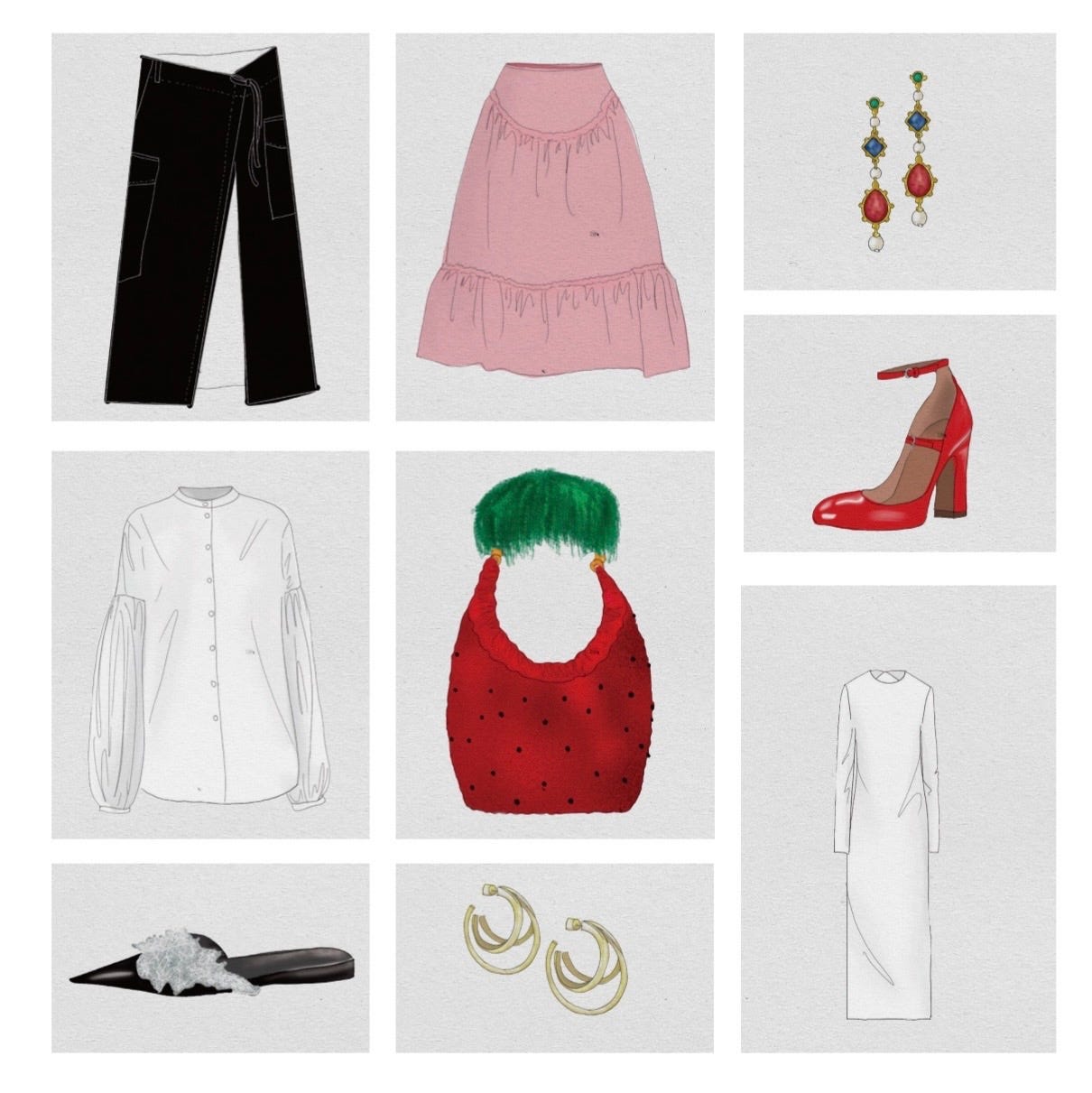
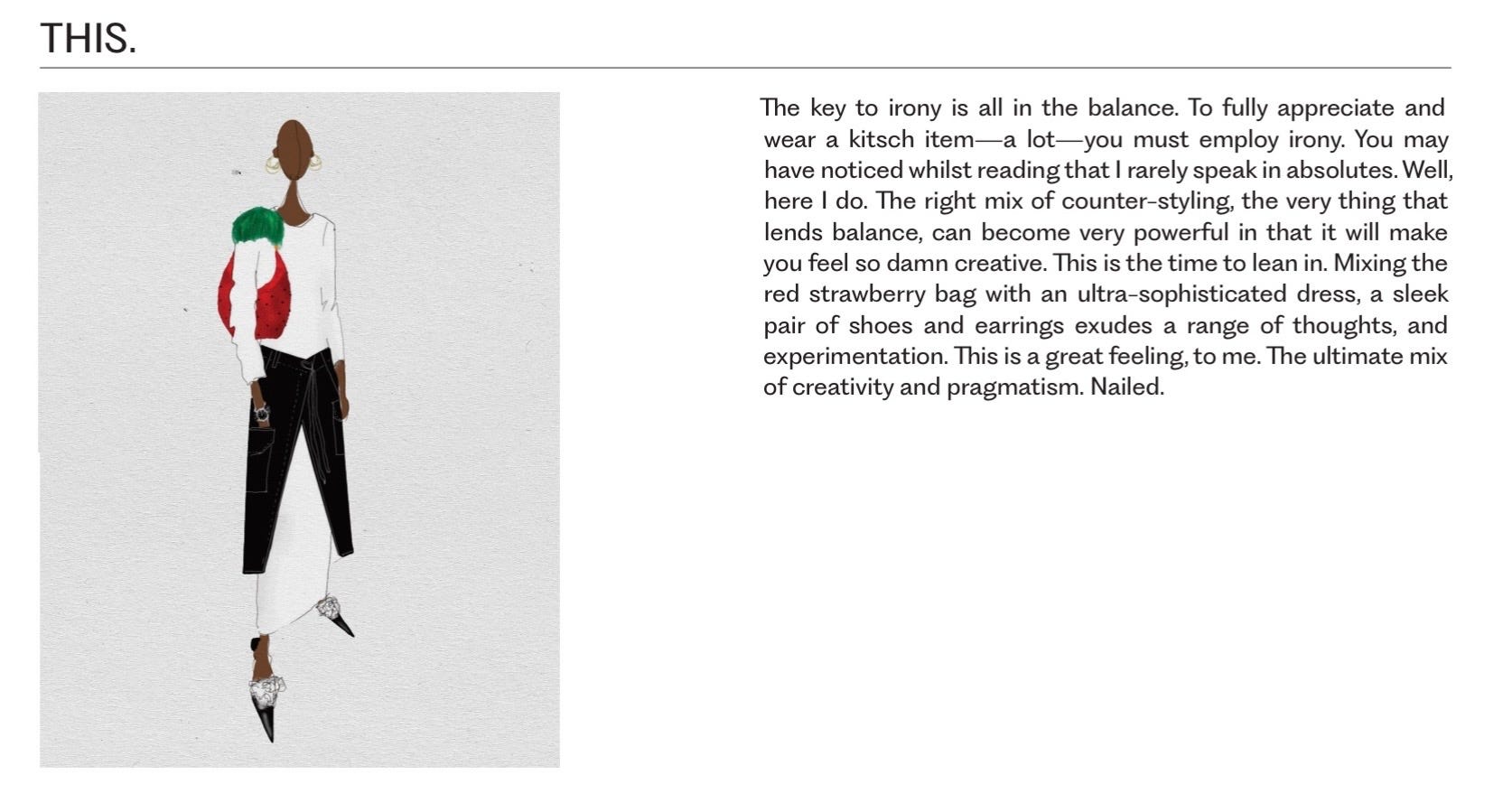
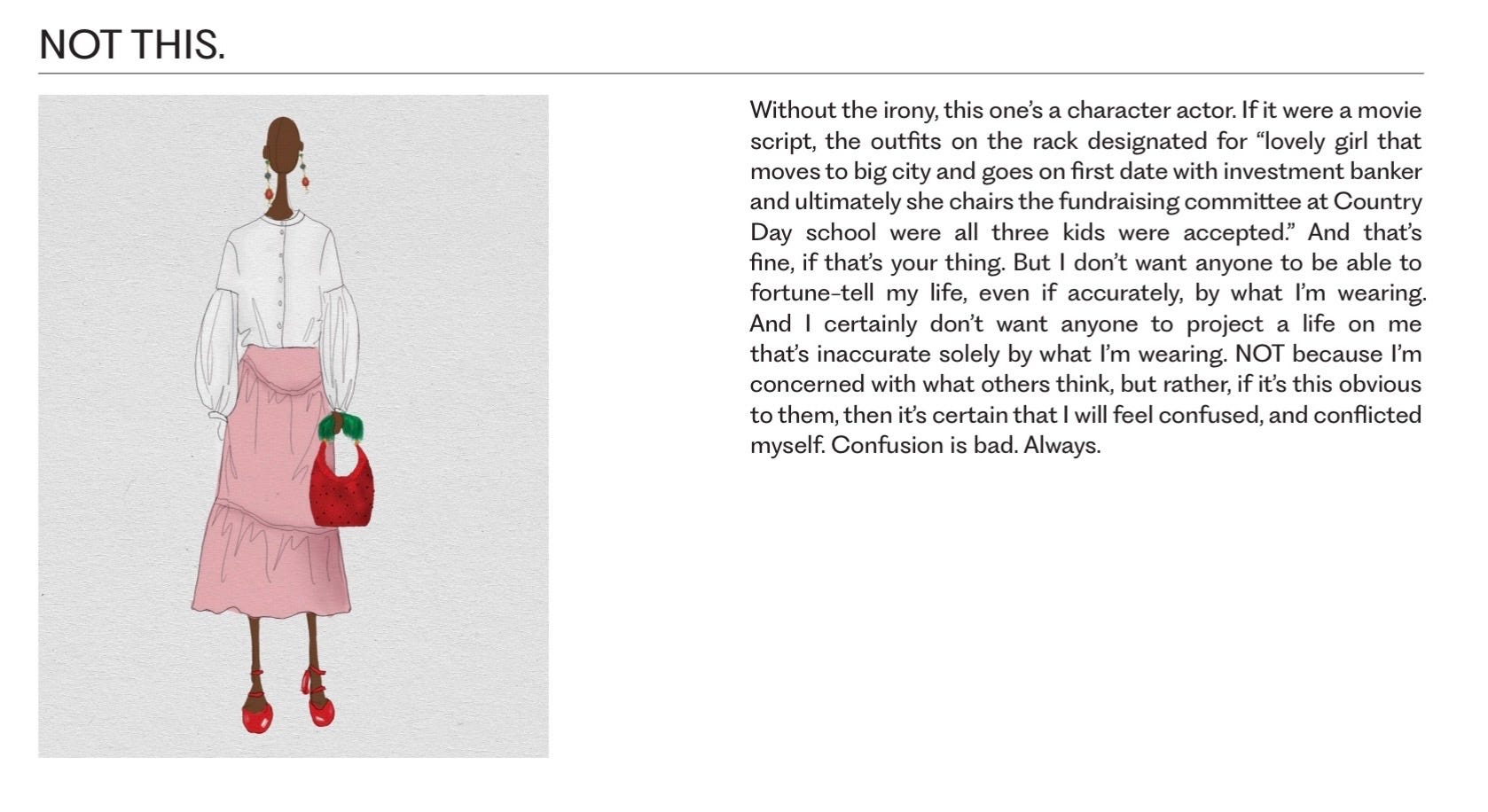
So you can see, I have a lot of friends right now who are scratching their head and thinking how much they love the “not this.” And they’d be right to do so- because objectively it looks lovely. But I know how I would feel in it, because it is hardly chill, lacks visual curiosity (to me), and it is classic. One of three. I need all three for balance.
I wrote The Creative Pragmatist for people who seek an intellectual conversation around personal style - not the banter of it all. That banter weighed so heavily on me for years, the conversations around a fashion show, coffee with a press person, I’d break out in literal and figurative hives. It turns out, many others felt the same way, we just couldn’t tell who the people were that didn’t want to end with a quippy statement about bracelets as candy for your arms.
If you give a Mouse a Cookie….
I wrote Almost Reckless because people began making the connection that these “style principles” were really fundamentally much deeper than pairing red with pink. They made sense as a way to live your life as well, a better life. It’s a good read.
If you’ve read the books, I’d love your thoughts here - what principles really hit, which ones moved well beyond the closet to your everyday life. OK?
I’m not confident it’s principles ( I’m still learning ) as I’ve come to use the CP book and Almost reckless as a re-alignment of sorts. To understand why some decisions I’ve made over the years I’ve never grown tired of while others seemed to move out of my orbit so quickly, has been empowering. I see humour in my best decisions, a desire to be ironic ( to me that really hits as you say “fit in but stand apart” ) and a want that now that my life is less corporate and structured that I still crave the feeling of the outside as reflection of the inside. Even if it’s just a coffee with a friend, a garden walk admiring their hard work .. or time alone at home.. The bifurcation that used to exist is going … I’d never have considered it to be there without these insights ❤️ and I suspect none the wiser ( it’s so good being a bit wiser 😊)
I’ve read the books and over the years the concept of Chill, Modern and Classic has become entrenched in my life far beyond clothing.
Just yesterday I was talking to my husband about what kind of parents we want to be — it occurred to me that my principles and philosophy around parenting follow the concept of Chill, Modern and Classic quite naturally. I respect and want to incorporate the rituals and traditions that have come before me (Classic) — inherited from our families and our respective cultures. I’m open-minded to newer and better ideas, and to learning from my kids (Modern, forward-looking). And I’d like to maintain some level of ease and calm while raising my kids, do things for myself, be pragmatic — I can’t be everything or do everything for my kids all the time (Chill).
Your articulation of these ideas — first through your style classes and later in your books — has resonated deeply. I feel so much more settled since discovering you and Tibi a few years ago.